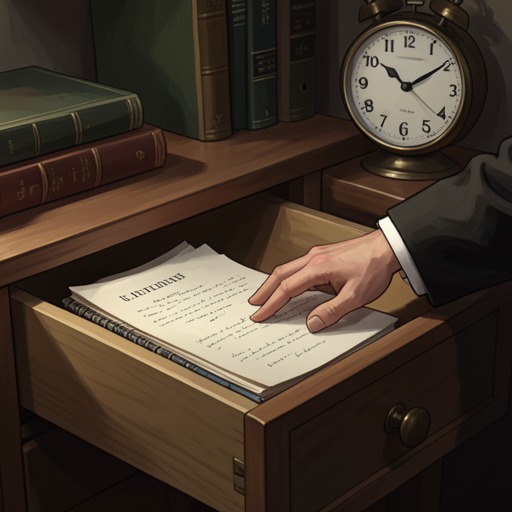
Crosbie Wells’s deed of gift, later signed by Anna
The LuminariesCrosbie Wells’s deed of gift, later signed by Anna is a damaged instrument at the intersection of a promised inheritance and a contested identity. It records Emery Staines’s promise of £2,000 to Anna Wetherell, witnessed by Crosbie Wells, but Staines’s signature is missing when the document is found. Anna supplies one herself, turning a charred paper recovered from a stove into a disputed claim whose force depends on what a signature can prove—and who has the right to write it.
The document and its recovery
Cowell Devlin produces the deed in the parlour at the Wayfarer’s Fortune, withdrawing it from the pages of his Bible and handing it to Anna without explanation. He says he found it in the bottom of Crosbie Wells’s stove on the day after Wells’s death. The paper is charred, but enough remains to identify its central terms: on 11 October 1865, £2,000 is to be given to Anna by Staines, with Wells presiding as witness. The instrument therefore connects the three figures through a specific promised sum and a recorded act of witnessing, even though it does not, by itself, establish that the gift was completed.
The deed arrives in a setting shaped by bereavement and legal uncertainty. Devlin has kept it concealed in his Bible rather than presenting it openly, and its damaged condition is part of its history: the evidence has survived a fire, but not in an undamaged or self-explanatory form. Anna, who has never learned to read, initially looks at it with uncertainty. Then she recognizes that she can make out the text and studies it closely. The document is not merely a clue for Devlin; it offers Anna direct access to a written promise made in her name.
The missing signature and Anna’s intervention
Devlin warns Anna that the instrument is legally defective. Staines did not sign it, he explains, and Wells’s witness signature is consequently invalid because the witness cannot sign before the principal. The deed thus contains a decisive gap: it sets out the promised payment and identifies the parties, but its prescribed sequence of signatures has not been completed. Devlin presents the defect as a reason the document cannot safely be treated as valid.
When Devlin leaves the parlour, Anna takes the deed to Lydia Wells’s writing desk. She uncorks the ink, takes up the pen, and writes Staines’s name in the space where his signature is required. The act is deliberate and swift. Anna has never seen Staines’s signature, yet she says she knows she has reproduced its form exactly: she describes the diminishing letters of his surname, the cheerfully illegible first name, the doubled curl before the E, the flattened S, and the casual underline. Her confidence in the imitation does not make it authentic; it shows instead how convincingly the appearance of a signature can be produced without the signer.
Devlin returns with the tea tray, sees what she has done, and confronts her. Anna does not retreat from the alteration. She insists that the signature is Staines’s and that the deed is good, while Devlin rejects that claim. The clash exposes the difference between a document’s written promise and the evidence required to authenticate it. The new signature may make the paper look complete, but its origin remains the central issue.
From hidden paper to courtroom evidence
Anna later brings the charred deed to the Hokitika Courthouse. Aubert Gascoigne and Alistair Lauderback have already left, and a solicitor, John Fellowes, receives her at a plain deal table in an alcove. Anna hands him the document without an explanation and says only that it was given to her anonymously. The exchange carries the deed out of Devlin’s private custody and into a legal setting, but the stated anonymity leaves its chain of possession unresolved.
The courtroom’s examination of the deed also draws attention to a separate document: the bill of sale for the barque Godspeed, submitted by Francis Carver. Walter Moody compares the handwriting on Carver’s bill with the signature attributed to Crosbie Wells on the deed and on Wells’s marriage certificate. He tells the court that the deed and marriage-certificate signatures match one another, while neither resembles the signature on the Godspeed bill of sale. His comparison supports the conclusion that the bill’s signature is forged. This finding does not authenticate Anna’s addition of Staines’s name; rather, it distinguishes Wells’s signature as witness from the suspect signature used by Carver to transfer the ship.
That distinction matters because the deed contains two separate questions of authorship. Wells’s name appears as witness, and Moody’s comparison treats that signature as consistent with Wells’s other documents. Staines’s name, by contrast, was absent until Anna wrote it. The court’s handwriting evidence can help expose Carver’s impersonation, but it cannot convert Anna’s imitation into Staines’s genuine act. The deed is therefore both evidence within a larger dispute over identity and an object whose own legal claim remains compromised by the way it was completed.
The deed among fortunes and false identities
The sum named in the deed belongs to a story in which wealth repeatedly travels through hidden or uncertain channels. Elsewhere, a trunk associated with Carver’s seizure of the Godspeed contains about £4,000 in gold sewn into five dresses; the lost crate prompts Carver to advertise under the name Crosbie Francis Wells, using a birth certificate to establish that identity. Separately, gold concealed around the real Crosbie Wells’s cottage is discovered after his death, while another portion remains hidden in Anna’s orange dress. These fortunes do not establish the deed’s validity or prove that its £2,000 was paid. They place its promised sum within a wider pattern in which possession, names, and documentary proof fail to align neatly.
The deed’s significance lies partly in that tension. It is a posthumous promise preserved in damaged form, hidden in a stove, carried in a Bible, altered at a writing desk, and presented in court alongside other records whose signatures are under scrutiny. Its history does not resolve the uncertainty between gift and claim. Instead, the paper makes that uncertainty visible: a written obligation may survive its maker, but the meaning and force of the surviving document depend on the provenance of its marks, the order in which they were made, and the people prepared to recognize them.